


Deep Plane Facelift
Serving Cincinnati, Ohio & the Tri-State Region- Dr. Harmon is one of few surgeons worldwide, and Cincinnati’s only surgeon, trained by extended deep plane facelift pioneer Dr. Andrew Jacono (1, 2, 3, 4).
- Published with Dr. Jacono in Aesthetic Surgery Journal on the extended deep plane facelift’s effects on the neck (2).
- Deep plane facelift surgery lifts multiple layers together, not just skin, to improve healing and reduce the chances of a pulled appearance
Contact Us

What is Deep Plane Facelift?
The deep plane facelift is a surgical procedure in which incisions are made around the ears and hairline to release and lift volume in the face that can fall with age. A small area of skin around the ears is lifted. Then, cheek fat and jowls are lifted along with muscle and connective tissue in the center of the face. This deep plane approach is extended into the lateral neck where skin and muscle are lifted to enhance the effects of a neck lift. A deep plane facelift procedure that extends the deep plane approach into the neck is called the extended deep plane facelift. Tight attachments in the cheek and lateral neck are released to minimize tension. This released facial and lateral neck volume are lifted together, superiorly and laterally, and secured under the skin. Excess skin is removed. The incisions are then closed under little tension. The intent of this procedure is to improve healing and reduce the risk of a pulled, distorted look when compared with older techniques (1, 2, 3, 4). The extended deep plane facelift technique does, however, require extensive training to perform successfully and consistently. Dr. Harmon is one of the few surgeons in the world – and the only surgeon in Cincinnati, Ohio – who is fellowship-trained through the American Academy of Facial Plastic and Reconstructive Surgery (AAFPRS) in the extended deep plane facelift by its pioneer, Dr. Andrew Jacono.
What Conditions Does the Procedure Address?
The purpose of deep plane facelift surgery is to lift volume in the cheeks and jawline that have fallen to create a more youthful, heart-shaped appearance to the face. The conditions deep plane facelift surgery, especially the extended deep plane facelift, can help address include:


Before & After
Explore our galleries to see the stunning, natural results delivered by one of the best facelift surgeons in Cincinnati, Dr. Harmon.
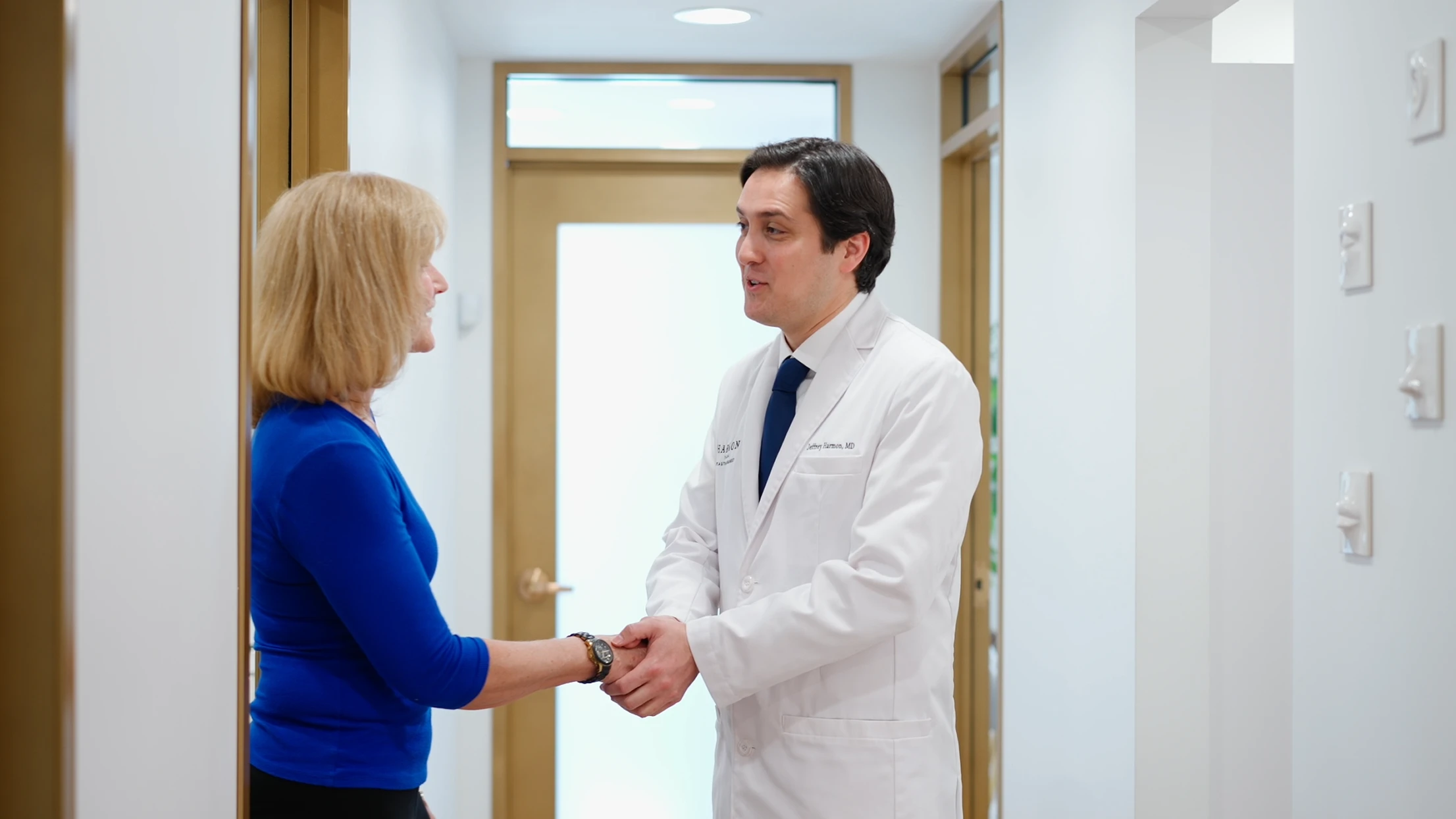


Why Choose Dr. Harmon
The desire for youthfulness is understandable. There is no area more important than the face. After all, the face cannot be hidden. It is how we present ourselves to the world. Dr. Harmon works with a refined eye and trained hands to develop a personalized treatment plan with you, utilizing advanced techniques in surgical and non-surgical care of the face, nose, eyes, neck and hair.
Fellowship trained facial plastic surgeons have a unique specialized skill set in performing surgical and non-surgical procedures on the face, nose, eyes, neck and hair. The pathway to becoming a facial plastic surgeon begins with five years of rigorous training in head and neck surgery. This training is focused on all aspects of surgery for the head and neck, in addition to aesthetic and reconstructive procedures.
A small pool of top performing graduates from head and neck surgery programs are then selected to complete sub-specialty training as a fellow in facial plastic and reconstructive surgery through the American Academy of Facial Plastic and Reconstructive Surgery (AAFPRS).
Dr. Harmon is part of this very small pool of fellowship-trained facial plastic surgeons with this level of subspecialty training in facial aesthetic surgery and the extended deep plane technique. In fact, he is one of the few surgeons in the world – and the only surgeon in Cincinnati, Ohio – who is fellowship-trained through the American Academy of Facial Plastic and Reconstructive Surgery (AAFPRS) in the extended deep plane facelift by its pioneer, Dr. Andrew Jacono.
Quad A Accredited Surgery Suite
Harmon Facial Plastic Surgery is proud to have a Quad A accredited operating room and facility in our office. Our single-physician, single-specialty facility meets or exceeds the strict guidelines and high standards set forth by Quad A, demonstrating our strong commitment to patient safety and excellence in surgical care. We utilize the services of board-certified anesthesiology physicians only as well as our own personal clinical support staff to ensure the most comfortable, safest experience for our clients.
Out-of-Town Patients
This level of care draws patients from across the Tri-State region, including Cincinnati, Ohio, Northern Kentucky, Indiana, and surrounding communities. Our team coordinates every consultation, procedure, and follow-up appointment for those traveling from outside the local area, so the distance is the only hard part.
Overview of the Procedure
The team at Harmon Facial Plastic Surgery works tirelessly to prepare patients well for their procedure. The time spent with patients and resources provided facilitates a smooth transition from the procedure through recovery. The following overview is a broad summary of the information provided to patients:
Procedure Consultation
Expect a detailed, informative discussion with Dr. Harmon about your concerns and aesthetic goals. He will develop a personalized treatment plan to address these concerns and goals.
Pre-Treatment Preparation
Patients receive a packet with detailed pre-operative instructions prior to surgery. This packet includes information on what supplements and medications to hold prior to surgery, activity restrictions, and what supplies are necessary for post-operative recovery. Prescriptions are sent prior to surgery with instructions on their use. Finally, if medical clearance is required, a form detailing the necessary clearance and testing is provided to present to their primary care provider.
Day of Treatment
Patients are instructed to arrive at the office in comfortable clothes. The surgical plan is discussed with the patient in detail. Paperwork is completed. Photos are usually taken pre-operatively. Finally, the patient meets the surgical team, which may include nurses, anesthesiologists, and/or scrub technologists, depending on the procedure(s) and type of anesthesia used. A loose-fitted dressing is applied and small drains are placed in the neck during surgery.
Follow-Up Appointment
Patients follow up one (1) day after surgery to remove the dressing. The drains may also be removed one (1) day after surgery, depending on the drain output. Patients may follow up on day two (2) after surgery as well. Subsequent follow up appointments are approximately five (5), seven (7), and ten (10) days after surgery to remove sutures.
Social Readiness
The exact time in which patients feel ready to socialize depends on multiple factors, including their comfort with the visibility of incisions, bruises, and swelling. Makeup can be applied to the neck approximately ten (10) days after surgery. Most patients feel ready to socialize approximately fourteen (14) days after surgery, though they are still healing and will continue to do so for months after surgery.
Ideal Candidates for a Deep Plane Facelift
Ideal candidates for deep plane facelift surgery include those patients who demonstrate age-related changes to their face such as:
- Jowls
- Fallen cheeks
- A loss of definition of the jawline, with the soft tissue of the face blending in with the neck
Most candidates for deep plane facelift surgery range in age from their forties (40s) to their seventies (70s). A consultation is essential to determine candidacy for the procedure, because there may be factors, medical and/or non-medical, that preclude this procedure for certain individuals.
For example, someone who does not exhibit drooping cheeks, jowls, and other signs of falling facial volume are less likely to be a good candidate for deep plane facelift surgery. Dr. Harmon does not perform a “preventative” facelift, in other words. Instead, he believes in treating what has changed. This, however, brings up the important question of how much change needs to occur before a deep plane facelift is indicated. There is no easy answer. It depends on several factors including, but not limited to, patient readiness and a consultation with Dr. Harmon to discuss treatment goals. However, many patients who are not good candidates for deep plane facelift surgery are good candidates for other surgical or non-surgical procedures Dr. Harmon performs. Examples include lateral temporal brow lift surgery, blepharoplasty (eyelid) surgery, and lip lift surgery.
Someone whose only goal is to “smooth” wrinkles spread across their face is also less likely to be a good candidate for deep plane facelift surgery. First, it is important to emphasize that a desire to smooth wrinkles is natural and reasonable. Wrinkles, also known as rhytids, are an often-prominent sign of facial aging. They can develop concurrently with the three-dimensional shift in volume deep plane facelift surgery is designed to treat effectively and in a natural-appearing way. There is, however, a difference between treating skin and deeper, structural facial aging. Fortunately, they can often be treated together with different procedures. Dr. Harmon has observed that hanging volume in the face – composed of multiple tissue layers, including the skin – is usually the more obvious sign of facial aging.
Reasonable expectations must be established about what deep plane facelift surgery can and cannot accomplish. As with all facial plastic surgery procedures, results can vary.
What to Expect from Recovery
Recovery from deep plane facelift surgery is specific to the patient. The initial recovery time from deep plane facelift surgery is approximately ten (10) to fourteen (14) days for most individuals. However, the duration of recovery will vary from person to person.
Dressings are removed the day after surgery. Drains, which are placed because a deep plane facelift is performed with a neck lift, are usually removed one (1) day after surgery if the drain output is appropriately low. Sutures are removed in a staged, progressive manner over approximately ten (10) days. Swelling and bruises are expected after deep plane facelift surgery. Post-operative swelling and bruises generally improve significantly by ten (10) to fourteen (14) days after surgery.
The healing process does not end after fourteen (14) days, however. For example, the incision continues to heal for months after surgery. Dr. Harmon has an incision care plan for his patients that extends for months after surgery and is intended to maximize healing. A laser resurfacing procedure can also be performed on the incisions starting a few weeks after surgery with an intention to accelerate the healing process. Swelling and bruises are expected to continue to improve and resolve in the ensuing days and weeks.
Drains are removed
Sutures are removed
Swelling and bruises are improved
Initial recovery
Benefits of a Deep Plane Facelift
A deep plane facelift helps address many features of age-related changes to the face. The potential benefits of a deep plane facelift include:
- Lifted cheeks, which can reduce the appearance of heaviness over the upper lip and create a more youthful interface between the cheeks and the lower eyelids
- Lifted jowls, which can make the jawline appearance longer and more youthful
- Improved definition of the jawline
- An overall transition from a bottom-heavy appearance to a more heart-shaped appearance to the face
Dr. Harmon’s observations based on his conversations with patients about facelift surgery inform his thinking about the tradeoffs inherent in each surgical approach. For example, he has noticed that other, older techniques may require less time to perform and may be performed using more limited anesthesia, sometimes without IV sedation. In contrast, Dr. Harmon performs an advanced form of deep plane facelift surgery developed by his fellowship director called the extended deep plane facelift. He feels it is important to have a controlled surgical environment while operating, something IV sedation or general anesthesia may be better suited for than if a patient were entirely awake. And, while deep plane facelift surgery can take longer to perform than other techniques, Dr. Harmon feels strongly that this is well worth it if effective, natural-appearing results can be achieved.
Risks of a Deep Plane Facelift
The potential risks of a deep plane facelift include, but are not limited to:
- Bruising
- Swelling
- Infection
- Bleeding
- Skin color changes
- Nerve damage
- Abnormal scarring
Combine a Deep Plane Facelift with Other Facial Enhancements
Deep plane facelift surgery complements other surgical and non-surgical procedures well. Procedures that complement deep plane facelift surgery include, but are not limited to:
Neck lift
A neck lift can refine the jawline and eliminate loose skin beneath the chin. It may complement the lift and contour achieved through a deep plane facelift. Together, they can help create seamless rejuvenation from the face through the neck.
Brow lift
A brow lift can enhance the expressive upper third of the face by gently lifting the brow and smoothing forehead lines. Paired with a deep plane facelift, it may support a more refreshed, balanced, and naturally elevated look.
Lip lift
A lip lift shortens the space between the nose and upper lip, enhancing lip definition and youthful proportion. When combined with a deep plane facelift, it can subtly complete the rejuvenation around the mouth.
Blepharoplasty
Rejuvenating the eyelids through blepharoplasty enhances brightness and clarity in the eyes, one of the most expressive facial features. This, paired with a deep plane facelift, may create a more comprehensive renewal with refined detail.
Rhinoplasty
Refining the nose with rhinoplasty may elevate the overall facial balance achieved with a deep plane facelift. This combination helps create aesthetic harmony in both profile and frontal views for a well-balanced and elegant look.
Fillers
Strategic use of fillers after a deep plane facelift can help fine-tune areas like the lips, chin, or under-eye hollows. This pairing allows for custom contouring that supports a soft finish that may elevate the overall effect.
Botox®
Botox® help smooth dynamic wrinkles and soften expressions, subtly enhancing the structural rejuvenation of a deep plane facelift. Together, they may promote a naturally relaxed, refreshed, and polished appearance.
Laser Skin Resurfacing
The facelift incisions can be treated with a laser resurfacing procedure as soon as a few weeks after surgery with an intention to accelerate the healing process.